

Abstract
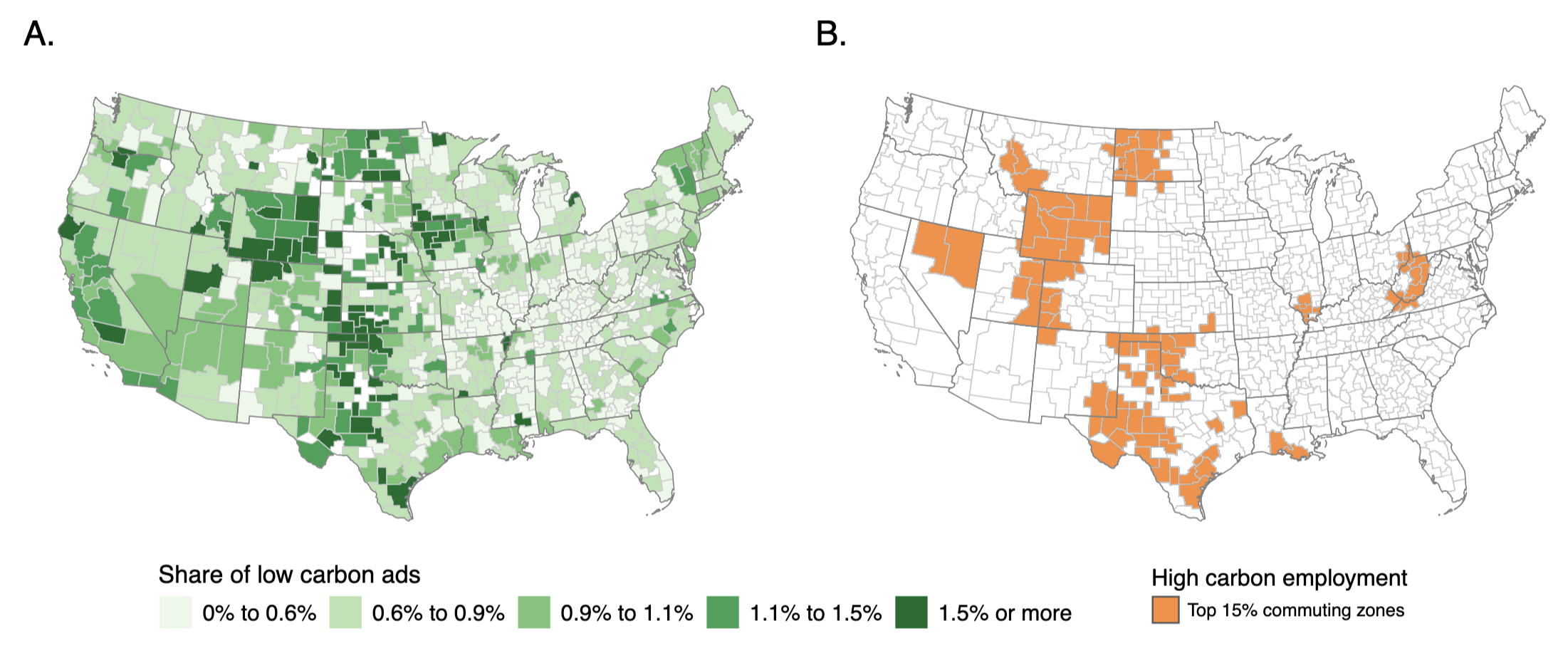
Standard occupational classifications obscure identifying which jobs directly contribute to decarbonization. Using U.S. online job vacancy data, we develop a transparent, skill-based approach that identifies low-carbon jobs within occupations, by combining advanced natural language processing with text linked to established green classifications. We show that low-carbon job creation is more prevalent in low-skilled occupations, yet low-carbon jobs systematically require more complex skill sets than comparable generic jobs in the same occupations. These higher skill requirements are associated with a modest wage premium that declines over time and is largely driven by firm fixed effects. Reskilling patterns and low-carbon wage premia vary substantially across occupations, and the latter are markedly smaller than the high-carbon wage premia, especially in STEM occupations. Finally, low-carbon jobs are more spatially correlated with high-carbon employment than just renewable energy jobs, but are also more prevalent in wealthier areas.
Suggested citation
Saussay, A., Sato, M., & Vona, F. (2026). Emerging skills and wage gaps in the low-carbon transition: evidence from online job vacancy data. Journal of the Association of Environmental and Resource Economists. Advance online publication, 4 September. https://doi.org/10.1086/743961.